This guide takes you from zero to a working agent: get the beta package, install it on a search head, assign the roles, add and test a provider, and ask your first question. A typical setup takes under 10 minutes once you have the package.
Requirements
In brief: Splunk Enterprise 9.4, 10.0, 10.2, or 10.4 on a search head with KV Store (or Splunk Cloud), outbound HTTPS from that search head to your LLM provider, and a credential for it. The full compatibility matrix is in Requirements.
Get the app
OS AI Agent is in beta and is not on Splunkbase yet. To try it, contact sales@outcoldsolutions.com: we send the app package and a license key for the beta, and support you through it. Install the package on your search heads only:
- Splunk Enterprise: Apps - Manage Apps - Install app from file, or unpack it into
$SPLUNK_HOME/etc/apps/. - Splunk Cloud: the same page installs it as a private app. Splunk Cloud runs AppInspect on a private app when you upload it, and the package is built and tested against that check set. See Splunk Cloud.
- Search head cluster: push it through the deployer, the same way you deploy any app.
No restart of your indexing tier is needed.
The app installs three custom roles, one search command (| osai), one alert action, and a background input that runs chat jobs.
Assign roles
OS AI Agent separates the people who configure it from the people who use it. Three roles ship with the app:
os_ai_agent_user- use Chat and run| osai. Grant this to anyone who should talk to the agent.os_ai_agent_admin- everything a user can do, plus manage providers, chat defaults, spend limits, the log level, guidance, and query templates on the Setup page. The license key, the activity trail and retention need a full Splunk administrator. Grant this to whoever owns the deployment.os_ai_agent_alerts- may be named as the “Run as” user of an app-shared alert’s investigation. Ships with no members; add users to it only when you set up alert investigations (see Alerts and schedules).
A full Splunk administrator (the built-in admin_all_objects capability) can use and configure the app without the first two roles. Assign roles under Settings - Roles. The capabilities behind them are covered in Security.
Add a provider
Open the app. Until a provider exists, Splunk sends you to the Setup page. On the Providers tab, press Add provider, choose the kind, and fill in the endpoint and credential:
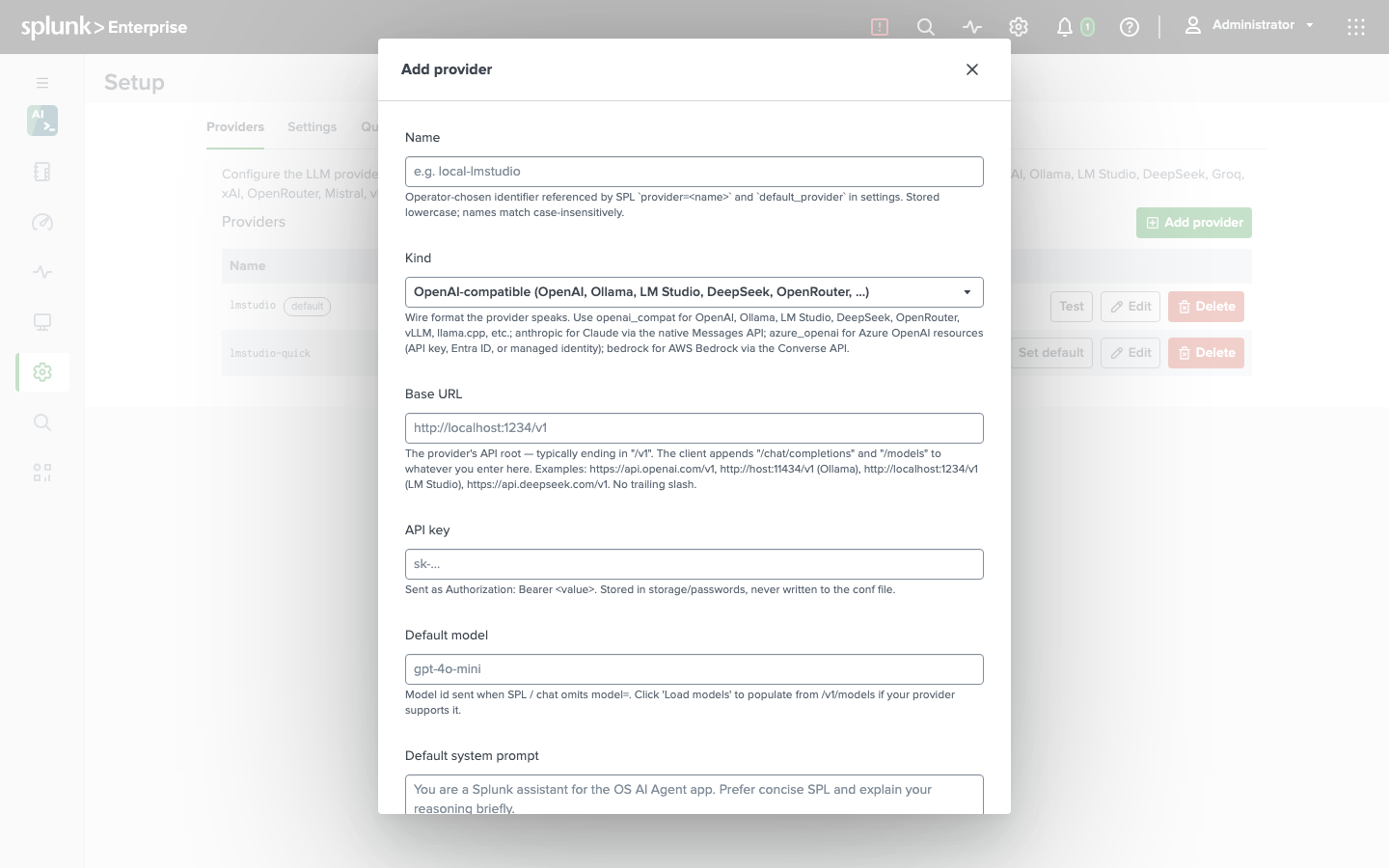
For OpenAI that is the base URL https://api.openai.com/v1, an API key, and a default model such as gpt-4o-mini. For a local model behind LM Studio or Ollama it is the server’s /v1 URL and no key. The API key goes into Splunk’s encrypted credential store and is never displayed again. Every kind, with its URL shape and authentication options, is in Providers.
Save, then press Load models on the edit form to pick the default model from what the provider offers, and Test on the provider’s row: the app runs a real completion through the whole chain - credential, endpoint, model - and reports the latency. The first provider you create becomes the default.
On the free tier you can configure one provider. Adding a second requires a paid license.
Saving the first provider clears Splunk’s setup gate. Splunk checks that gate at sign-in, so reload Splunk Web (or sign out and back in) before opening Chat.
Have your first conversation
Open Chat and ask something the agent can answer from your deployment:
What indexes do I have, and which one grew the most in the last 24 hours?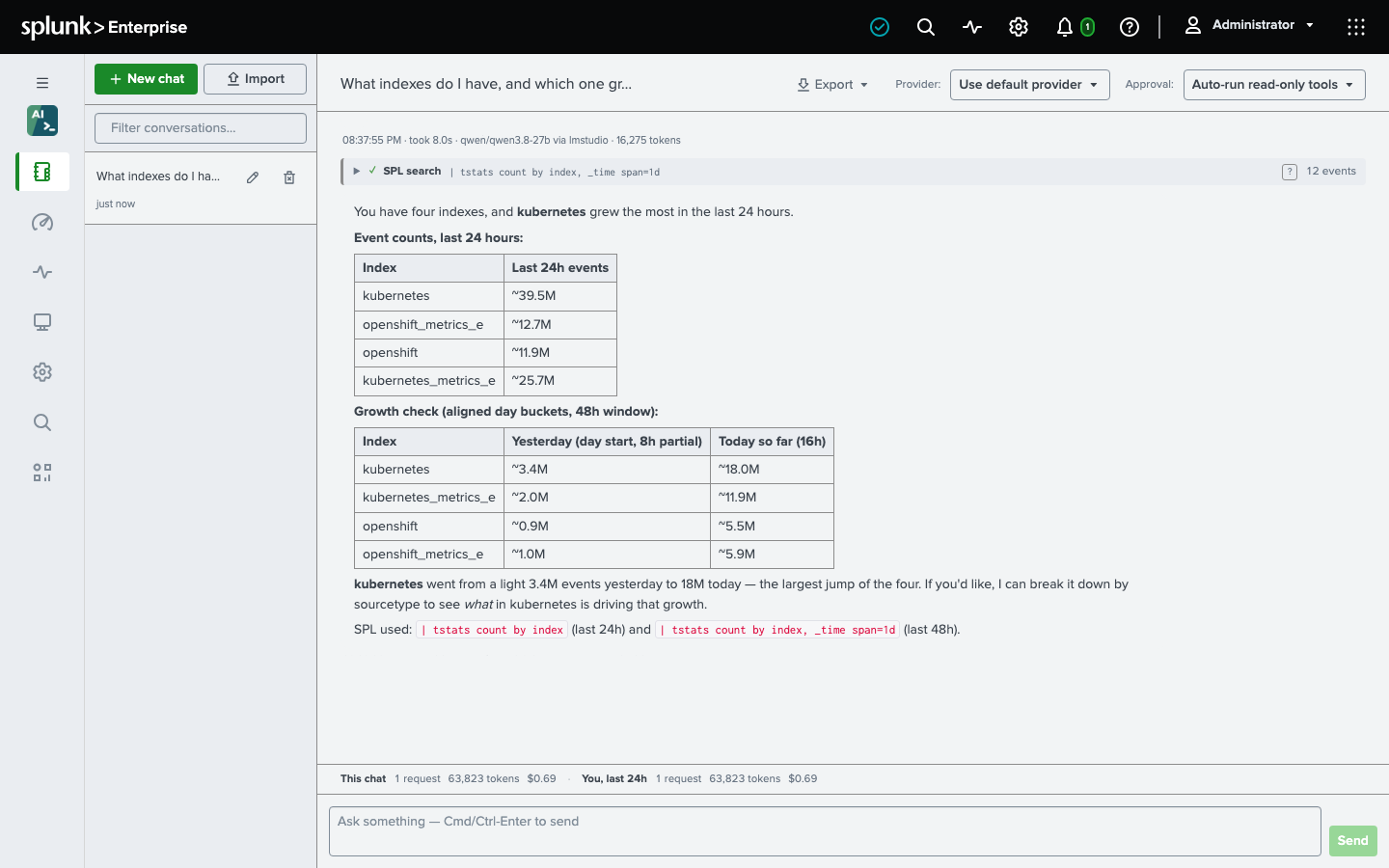
The agent lists your indexes, runs a bounded search, and answers with the numbers - each tool it ran appears as a one-line card you can expand to see the exact SPL and result. Read-only tools run without asking. Ask it to build something and it pauses instead:
Build a dashboard with error counts by sourcetype for index=payments over the last 7 days.An approval card shows exactly what will be written; Approve it, Deny it with a reason the agent adapts to, or edit the parameters first. See Chat.
Call it from SPL
The same agent is a search command:
| osai prompt="Summarize what a 503 from an API gateway usually means, in two sentences"| osai explain="index=payments sourcetype=api | stats count by status | sort -count"The full syntax is in The osai command.
Free tier and licensing
OS AI Agent runs with no license key on the free tier: one provider and one user - the seat is claimed by the first person a run is submitted for, whether from Chat, | osai, or an alert investigation - for non-commercial use. A paid license lifts the provider cap, enables everyone holding the app’s capability, and covers commercial use. See Licensing.
Search head clustering
In a search head cluster, deploy the app through the deployer. Providers, settings, and the license replicate to every member; conversations and jobs live in KV Store; and each chat job is claimed by exactly one member, so a conversation started on one member continues on whichever member runs it.