Providers, the license, and the query templates each have their own tab on the Setup page. The situational guidance notes are on the Guidance tab, and everything else an operator tunes is on the Settings tab: the chat defaults, the spend limits, how long the app keeps what it stores, the activity trail, and the log level. All of it lives in os_ai_agent.conf.
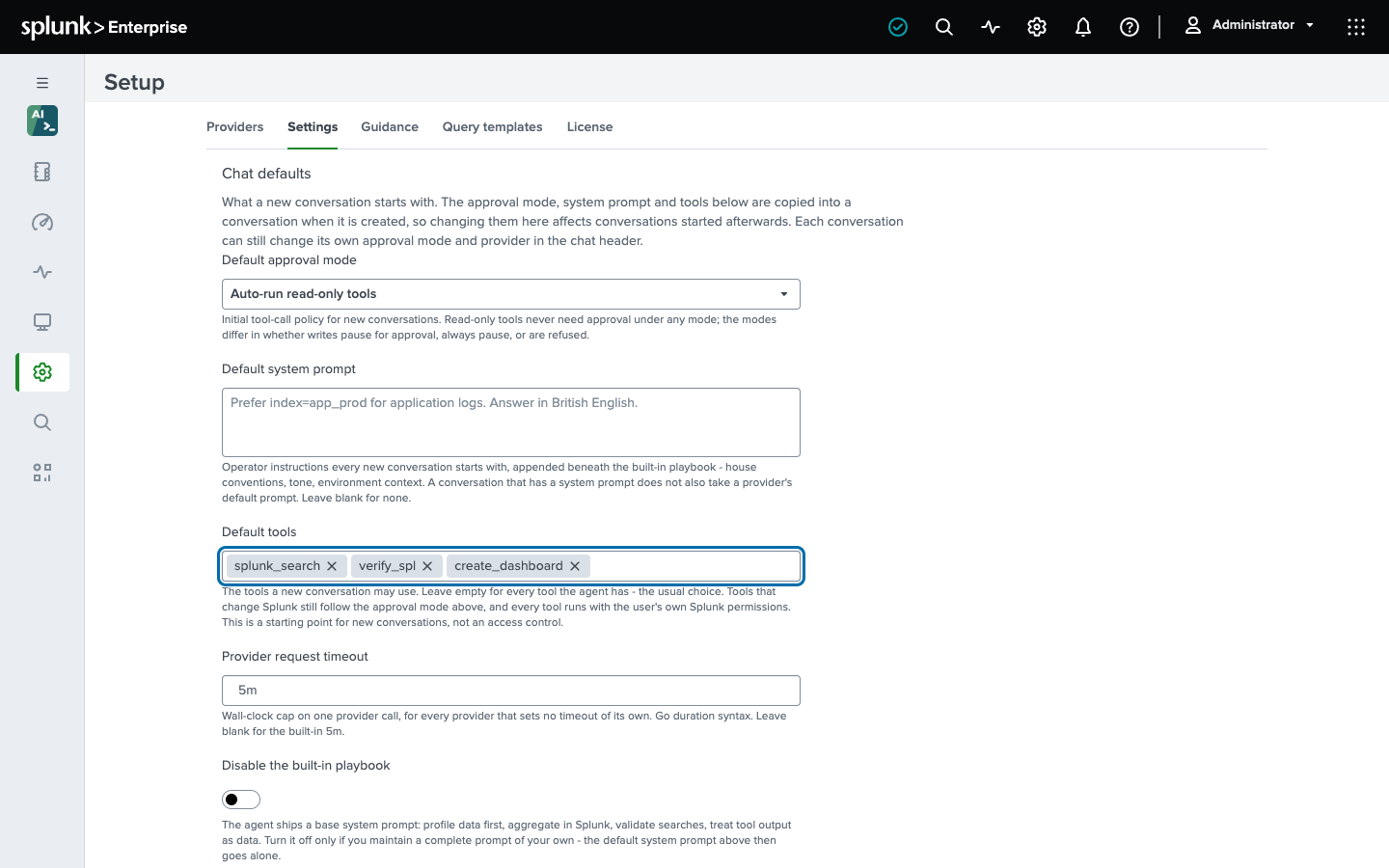
A field left blank keeps the built-in default, and the help under each field says what that default is. The search command and the REST handlers read a change on their next request; the background chat worker reads it at the start of its next pass - within seconds when it is idle, and once the pass in progress ends when it is busy. On Splunk Cloud the tab is the only way to set these values; on a self-managed search head you can also edit the file:
$SPLUNK_HOME/etc/apps/os_ai_agent/local/os_ai_agent.confAn app upgrade overwrites default/, so a value set there is lost on the next release; local/ always wins and survives upgrades, and the Setup page writes local/ for you. The bundled README/os_ai_agent.conf.spec is the exhaustive schema.
Chat defaults
The [chat] stanza, plus the global provider timeout in [settings].
The approval mode, the system prompt, and the tools are a new conversation’s starting point. They are copied into a conversation when it is created - from the chat page, the REST API, or the alert action - wherever the request names no value of its own. Changing one affects conversations started afterwards; an existing conversation keeps what it was created with, and its own approval mode stays the user’s to change. A complete import is the one create that does not take them: it reproduces a conversation, so the archive’s settings are kept exactly, empty ones included. A REST caller asks for the same with apply_defaults: false on the create.
| Setting | Default | What it does |
|---|---|---|
default_approval_mode | auto_approve_read_only | The tool-call policy a new conversation starts with: auto_approve_read_only (writes pause, reads do not), approve_all (every tool pauses), or approve_none (writes are refused). Each conversation can change its own. |
default_system_prompt | (empty) | Operator instructions every new conversation starts with, appended beneath the built-in playbook - house conventions, tone, environment context. A conversation that has a system prompt does not also take a provider’s default system prompt, which applies only to a request that carries none. |
default_tools | (empty) | The tools a new conversation may use, as a comma-separated list of tool names; the Settings tab offers the agent’s own list and marks the tools that change Splunk. Empty means every tool, which is the usual choice. Tools that change Splunk still follow the approval mode. This is a starting point, not an access control: a caller of the REST API can name a different list, and what a tool may read or change is always bounded by the user’s own Splunk permissions. See Tools. |
disable_builtin_system_prompt | false | Drop the built-in playbook - profile data first, aggregate in Splunk, validate searches, treat tool output as data - and send only your own prompt. For operators who maintain a complete prompt. |
disable_guidance | false | Send none of the situational notes (see below). |
max_guidance_bytes | 0 (4096) | How much guidance one turn may carry; it is re-sent on every provider call of the turn. |
disable_tool_result_compaction | false | Always send the full history. By default, older bulky tool results go to the model as short placeholders (the stored conversation keeps them), which keeps long sessions inside small models’ context windows and cuts cost on paid ones. |
[settings] request_timeout | 5m | Wall-clock cap on one provider call, for every provider that sets no timeout of its own. |
[settings] worker_concurrency | 4 | How many chat runs the background worker on one search head executes side by side; the rest wait as Queued. Each is a streaming connection to its provider plus its tool calls against Splunk, and on a search head cluster every member has its own pool. 1 runs them one at a time; the most is 32. |
1[chat]
2default_approval_mode = approve_all
3default_system_prompt = Prefer index=app_prod for application logs. Answer in British English.
4default_tools = splunk_search, profile_data, list_indexes, verify_spl, get_spl_command, current_time
Spend limits
The [limits] stanza. Every budget is off by default and enforced over a rolling 24-hour window, not a calendar day. Cost budgets count only providers you have priced. See Costs and limits for what is counted and what is not.
| Setting | Default | What it does |
|---|---|---|
max_active_jobs_per_user | 10 | How many chat runs one user may have unfinished at once, across Chat and the REST API: queued, executing, or paused on an approval card. A run that waits for approval keeps its slot until you approve, deny, or cancel it. A negative value removes the cap. |
daily_tokens_per_user | 0 (unlimited) | Total tokens one user may consume in the last 24 hours before new runs are refused. |
daily_cost_per_user_usd | 0 (unlimited) | Recorded spend one user may reach in the last 24 hours. |
daily_cost_usd | 0 (unlimited) | Recorded spend across every user in the last 24 hours. |
Retention
The [retention] stanza, which only a full Splunk administrator (admin_all_objects) may change - the app’s own administrator role sees it read-only. Chat state lives in KV Store - conversations, messages, finished job records, usage rows, feedback - and KV Store never ages anything out on its own. These settings, in days, bound it; the chat worker applies the cutoffs about once an hour, and on a search head cluster exactly one member sweeps each hour. 0 keeps forever.
| Setting | Default | What it does |
|---|---|---|
disabled | false | Turn the sweep off entirely. Nothing is deleted while this is true. |
trash_days | 7 | How long a deleted conversation and its messages survive - an undo window. |
jobs_days | 30 | How long a finished run’s execution record is kept: the bulkiest rows the app writes, duplicating what the conversation and the usage ledger already hold. Queued, running, and paused jobs are never touched by age. |
models_cache_days | 7 | The per-provider model list, refetched on demand. |
threads_days | 0 | Age out live conversations by last activity. This deletes history nobody asked to lose, so it is off unless you set it. |
usage_days | 0 | Age out the token and cost ledger. Shortening it shortens how far back the Token Usage dashboard can report. |
feedback_days | 0 | Age out thumbs up and down. |
The Health dashboard shows every collection’s size next to these settings.
Activity trail
The [audit] stanza, which only a full Splunk administrator (admin_all_objects) may change - the app’s own administrator role sees it read-only. The trail is one JSON event per agent turn, per tool call, and per refusal, written to $SPLUNK_HOME/var/log/splunk/os_ai_agent_audit.log, which Splunk’s own default monitor indexes into _internal as sourcetype=os_ai_agent:audit. There is no index to provision. It records what nothing else can: which conversation changed a dashboard, which tool call made it, whether a person approved it or a policy did, and what the agent was refused permission to do. The Activity Trail dashboard reads it.
| Setting | Default | What it does |
|---|---|---|
disabled | false | Stop writing the trail. |
max_file_size | 64MB | Size at which the log rotates. File only. |
keep_files | 2 | Rotated generations to keep. File only. |
Logging
The [logging] stanza.
| Setting | Default | What it does |
|---|---|---|
level | info | Master verbosity of the chat worker, the setup handlers, and the search command: trace, debug, info, warn, error, or fatal. Raise it while you reproduce an issue, then put it back. |
levels.<component> | - | Raise the level for one component without flooding the rest, for example levels.os_ai_agent/internal/provider/openai = debug for the OpenAI-compatible calls. The component list is in README/os_ai_agent.conf.spec. File only. |
Situational guidance
The Guidance tab, which writes [guidance:<name>] stanzas. A note is a short piece of guidance the agent appends to its system prompt when a request touches what the note covers, selected by whole-word match against the user’s message - so a note that applies to a tenth of requests costs a tenth of what it would as a permanent prompt. Nine ship with the app: alert-hygiene, dashboard-tokens, field-extraction, metric-indexes, null-handling, search-performance, subsearch-limits, time-bounds, and tstats-and-acceleration. All nine are about SPL and Splunk itself; none describes a particular product’s data, which is what your own notes are for.
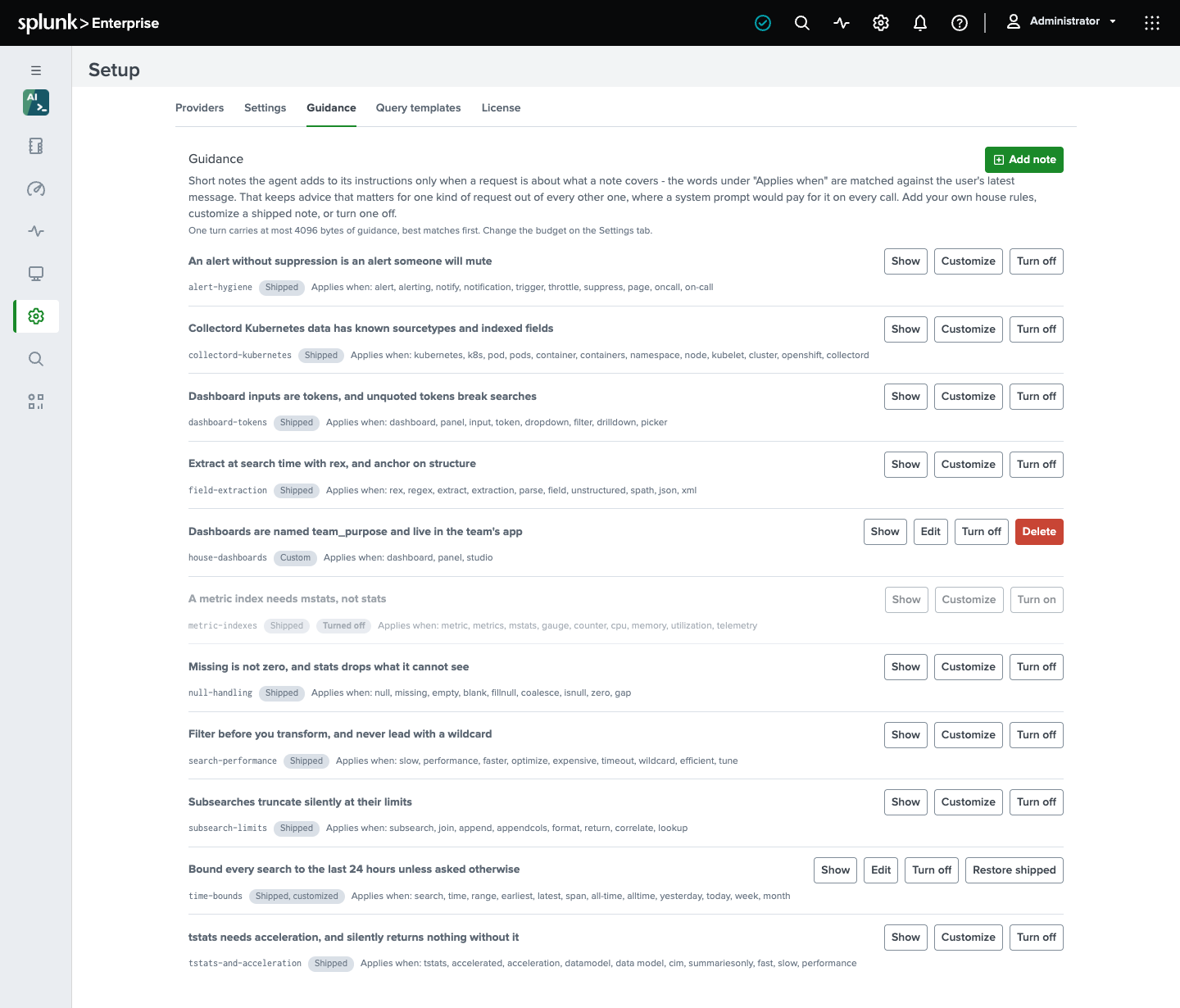
The tab lists every note, shipped and your own, with the words that bring it into a request. From there you can:
- Add note - your own house rule: a name, a title, the “applies when” words, and the note text in Markdown. Turn on Every request for a rule that genuinely applies to all work; it is then paid for on every provider call.
- Customize a shipped note. The form opens on the shipped text, and what you save replaces it. Restore shipped brings the original back.
- Turn off a note, shipped or your own, without losing its text, and Turn on to bring it back.
- Delete a note of your own.
The list is the agent’s own view, not a reading of the file. A note the agent will not use says so, and why: it has no title or no text, it has no “applies when” words and is not marked for every request, or it is larger on its own than the guidance budget for one turn, which the agent would otherwise skip silently on every request. If a customized shipped note is refused, the row says the shipped text is still the one in effect; a customized note that is only too large has still replaced the shipped one, so the row says that neither is sent. Disable situational guidance and the guidance budget are on the Settings tab.
In the file, a note is a stanza with a title, the words that put it in scope, and a body in Markdown; a stanza named after a shipped note replaces it, and disabled = true on such a stanza removes it:
1[guidance:payments-index]
2title = Payments application logs live in index=payments, not index=app
3match = payments, checkout, cart
4body = The payments team's services log to index=payments with sourcetype=payments:api. \
5  Latency is in the field duration_ms. Never search index=app for them.
6
7[guidance:alert-hygiene]
8disabled = true
Multi-line bodies continue a line with a trailing backslash. Set always = true on a note that genuinely applies to every request - it is then paid for on every provider call. A note’s name is lowercase letters, digits, -, and _; the agent compares names without regard to letter case, so a hand-written [guidance:Payments-Index] is the note payments-index on the tab.
Connection to splunkd
The [splunk] stanza governs how the app reaches the local splunkd REST API for credential lookups and the agent’s own tools - not how it reaches your provider. The defaults match a standard install and pin the connection to splunkd’s own certificate on loopback; you will not normally change them. README/os_ai_agent.conf.spec documents request_timeout, tls_ca_file, tls_cert_file, tls_server_name, tls_server_name_from_cert, and tls_insecure in full.
The chat worker
The background input that runs chat jobs is os_ai_agent_worker://default in the app’s inputs.conf, enabled with a 60-second interval. It does no external egress until a job exists. Manage it like any modular input under Settings - Data inputs; disabling it stops asynchronous chat and the retention sweep, and the Health dashboard and health endpoint say so.